




TABLE OF CONTENTS
Incident Response Runbooks: Building Ones Your Team Will Actually Follow

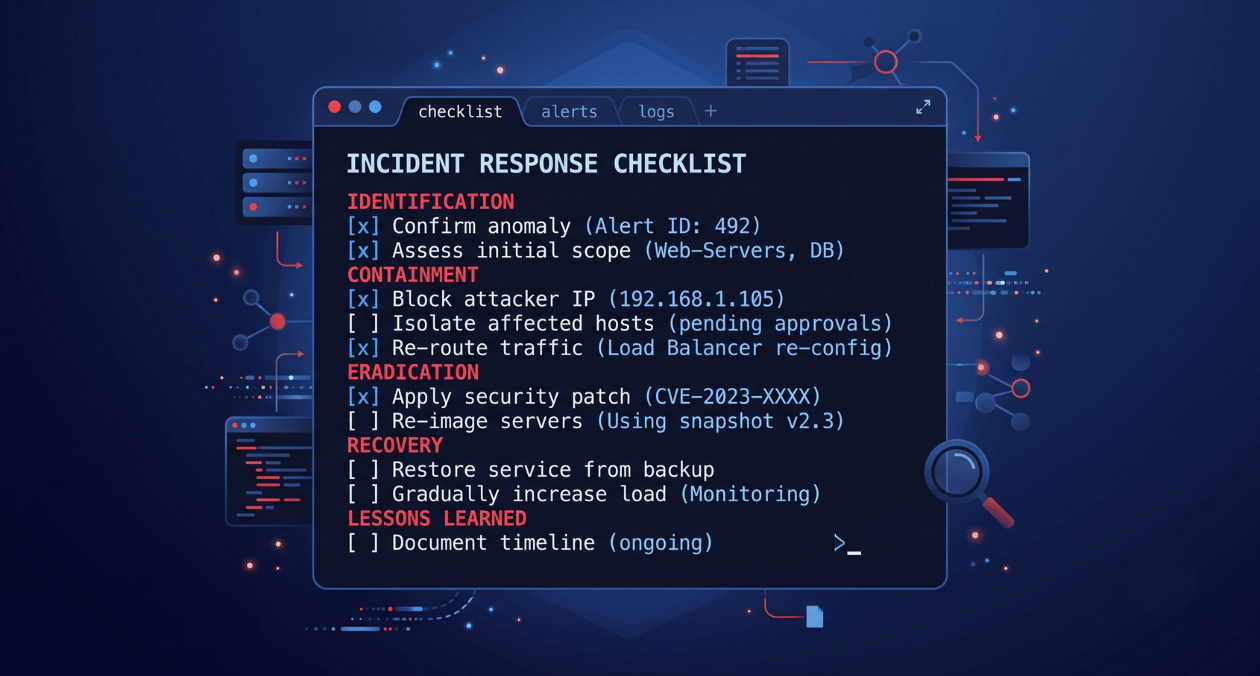
Most engineering teams have an incident response runbook sitting in a wiki somewhere, and most of those runbooks get ignored the moment a real incident hits, because whoever is paged defaults to instinct and Slack messages instead. The gap between having a runbook and having a runbook people actually follow under pressure comes down to a handful of design choices most teams get wrong.
Why Most Runbooks Fail Under Real Pressure
A runbook written as a long, prose-heavy document reads fine during a calm afternoon review but becomes nearly useless at 3am when someone is trying to diagnose a production outage under real stress. Cognitive bandwidth drops sharply during a genuine incident, and a runbook that assumes calm, careful reading simply will not get used the way it was designed to be used.
Design Principles That Actually Get Followed
| Design Choice | Why It Works Under Pressure | Common Mistake |
| Checklist format, not prose | Scannable in seconds, hard to skip steps | Long paragraphs nobody reads mid-incident |
| Clear escalation triggers | Removes ambiguity about when to escalate | Vague guidance like escalate if needed |
| Single source of truth location | No time wasted searching multiple docs | Runbooks scattered across wikis and docs |
Structuring the Escalation Path Clearly
Ambiguity about when to escalate is one of the most common failure points in incident response. A runbook that says escalate if the issue seems serious puts the entire judgment call on someone who may be new to on-call rotation or unfamiliar with the specific system involved. Concrete, specific triggers, error rate exceeds X percent for Y minutes, or a named critical service is fully unavailable, remove that ambiguity and let someone act quickly and confidently even under pressure.
On-Call Runbook Structure That Works
- A one-line summary of what the incident type looks like and how to confirm it
- Immediate first actions, in strict checklist order, not prose
- Clear, specific escalation triggers with named contacts or channels
- Rollback or mitigation steps, if applicable, listed as concrete commands rather than general guidance
- A pointer to the postmortem template, so the transition from active incident to retrospective is frictionless
Keeping Runbooks From Going Stale
A runbook that was accurate six months ago but never updated after a system migration is often worse than no runbook at all, since it actively misdirects someone during a real incident. Tying runbook review to any significant infrastructure change, rather than a fixed quarterly review cycle alone, catches the drift that a calendar-based review often misses between scheduled checks.
Connecting Runbooks to Postmortems
A postmortem template that flows directly from the runbook used during the incident makes the retrospective process faster and more consistent, since responders are documenting against the same structure they just followed rather than starting from a blank page. This connection also surfaces runbook gaps directly, if a postmortem repeatedly notes a step that was not in the runbook, that is a clear signal the runbook itself needs updating.
Teams building out this discipline for the first time can review Askan’s engineering reliability and culture coverage for related guidance on structuring on-call rotations and postmortem processes that pair well with a checklist-first runbook approach.
Most popular pages
-

Image Optimization for Web Performance: Formats and Compression
Ask a developer why a page feels slow, and the honest answer is often sitting right in the middle of it. A single unoptimised...
-

Monolith vs Microservices: Choosing the Right Architecture for Your Team
Microservices have dominated architecture conversations for years, to the point where choosing a monolith can feel like admitting you're behind the times. In practice,...
-

Magento Performance Tuning: Caching Layers Explained
Magento has a reputation for being resource-heavy, and while some of that is inherent to running a full-featured enterprise commerce platform, a large share...
Image Optimization for Web Performance: Formats and Compression
Ask a developer why a page feels slow, and the honest answer is often sitting right in the middle of it. A single unoptimised...
Monolith vs Microservices: Choosing the Right Architecture for Your Team
Microservices have dominated architecture conversations for years, to the point where choosing a monolith can feel like admitting you're behind the times. In practice,...
Magento Performance Tuning: Caching Layers Explained
Magento has a reputation for being resource-heavy, and while some of that is inherent to running a full-featured enterprise commerce platform, a large share...