




TABLE OF CONTENTS
AI Agents in Production: Separating Real Use Cases from Hype in 2026

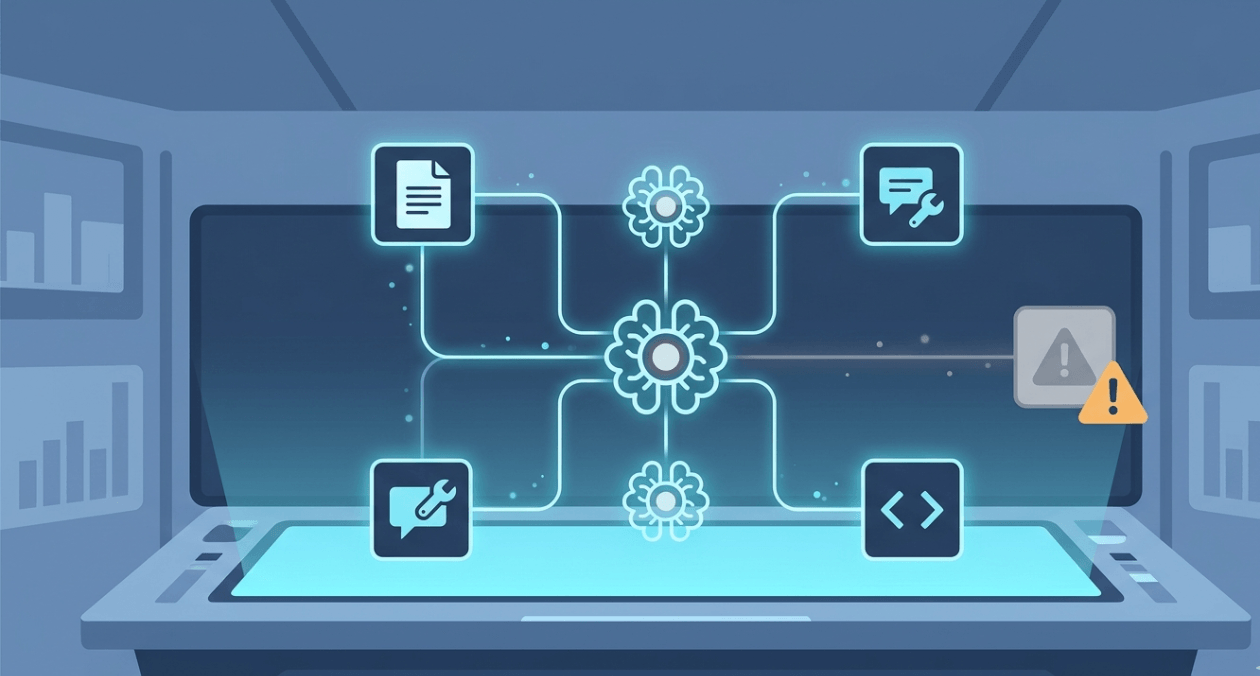
Every engineering roadmap in 2026 seems to mention AI agents production use cases somewhere on the slide. Vendors talk about autonomous coworkers, boardrooms talk about headcount savings, and most teams end up with a chatbot wrapped in a new name. The honest picture is more mixed. Some agentic workflows engineering teams have shipped are already saving real hours every week. Others are stuck in demo mode, impressive in a sandbox and fragile the moment real users touch them.
This piece is written for engineering leads and CTOs who need to decide where autonomous AI agents deserve budget this year, and where the label is doing more marketing work than technical work. According to a recent analysis, the 2026 Hype Cycle for Agentic AI places agentic AI near the peak of inflated expectations, with only a small share of organisations having actually deployed agents into production while a much larger share expect to within two years. That gap between intent and execution is exactly where this article sits.
What Actually Counts as an AI Agent in Production
A production AI agent is not just a prompt with a nicer interface. It is a system that observes some state, decides on an action from a set of tools, executes that action, and adjusts based on the result, largely without a human approving every step. That last part is where LLM agent reliability becomes a real engineering problem rather than a prompt engineering exercise.
Three traits separate a genuine agent from a glorified script. First, it makes a decision using the model rather than following a fixed if-then tree. Second, it can call more than one tool and choose between them based on context. Third, it can retry, escalate, or hand off when something goes wrong, instead of simply failing silently. If a system is missing all three, it is likely a workflow automation tool with an AI label attached, not an agent.
This distinction matters for budgeting as much as for architecture. A workflow automation tool with a language model bolted on for text generation is a much cheaper, much more predictable thing to run than a true agent making independent tool selection decisions across dozens of interactions a day. Confusing the two categories during planning is one of the most common reasons agent projects come in over budget, since teams price out the simpler system and then build the harder one.
Where Agents Are Already Earning Their Keep
The use cases that are working today share a common shape: narrow scope, clear success criteria, and a human still in the loop for anything irreversible. Support triage, internal code review assistance, and structured data extraction from documents are the categories showing up most often in production deployments right now, not general purpose digital employees.
| Use Case | Maturity in 2026 | Typical Owner |
|---|---|---|
| Support ticket triage and routing | Production ready | Support engineering |
| Code review and PR summarisation | Production ready | Platform teams |
| Document and invoice data extraction | Production ready | Backend teams |
| Fully autonomous customer negotiation | Early experimentation | Product / R&D |
| Self-directed infrastructure changes | Early experimentation | SRE / DevOps |
Notice the pattern. The mature column is full of tasks with a bounded blast radius and an easy way to check correctness. The experimental column is full of tasks where a wrong decision is expensive or hard to reverse. That single distinction predicts adoption maturity better than any framework name on a vendor’s website.
Where the Hype Is Still Ahead of the Engineering
The gap between demo and production usually shows up in three places: cost, latency, and failure handling. A demo agent that calls a model four times to answer one question looks fine with five testers. The same pattern at ten thousand daily active users turns into a real bill and a real support queue when the fourth call times out.
Multi-agent systems, where several specialised agents hand off work to each other, are frequently presented as the next stage of maturity. In practice, most teams that attempt this before nailing single-agent reliability end up debugging emergent behaviour across two systems instead of one. It is worth treating multi-agent orchestration as a stage two problem, not a starting point.
There is also a people problem hiding inside the hype cycle. Job postings and internal roadmaps increasingly assume that any backend engineer can pick up agent development as a side skill, when in practice debugging a system whose behaviour is only partly deterministic requires a different mental model than debugging a REST endpoint. Teams that invest in a small amount of dedicated training around prompt design, evaluation datasets, and failure mode analysis tend to ship agents that behave predictably far sooner than teams that treat it as business as usual.
Reliability Patterns Worth Building In From Day One
Teams that have moved agents into production successfully tend to converge on the same handful of guardrails, regardless of which model or framework they started with. These overlap closely with the broader patterns for running LLM systems reliably in production that apply to any generative AI feature, agentic or not.
| Pattern | What It Solves |
|---|---|
| Tool allowlists with scoped permissions | Limits blast radius of a bad decision |
| Structured output validation before execution | Catches malformed actions before they run |
| Confidence based human handoff | Routes uncertain cases to a person instead of guessing |
| Per step timeout and retry budget | Stops one slow call from stalling the whole task |
| Full trace logging of decisions and tool calls | Makes post incident review possible |
None of these patterns are exotic. What is new is treating an agent’s decision path with the same rigor a payments team applies to a transaction, complete with audit trails and rollback plans, rather than treating it like a clever autocomplete feature.
Cost tracking deserves its own callout here. Agentic workflows tend to make an unpredictable number of model calls per task, since the agent itself decides how many steps a problem needs. Teams that skip per task cost ceilings often discover the bill only after finance flags an anomaly, by which point the agent has usually been looping on a task it could not resolve. A simple cap that forces a handoff to a human after a fixed number of steps costs almost nothing to build and prevents most runaway spend scenarios outright.
A Short Checklist Before an Agent Reaches Real Users
Before greenlighting an agent for production traffic, most reliability focused teams walk through a short set of questions. If any of these are unanswered, the project usually is not ready, no matter how good the demo looked.
- Can every action the agent takes be undone or is there a manual recovery path
- Is there a hard ceiling on cost per task and per user
- Does the system degrade to a safe default when a tool call fails
- Is there a person who reviews a sample of agent decisions every week
- Can you reconstruct exactly why the agent made a specific decision after the fact
Building Agents That Survive Contact With Real Traffic
Security is the other place where enthusiasm regularly outruns engineering discipline. An agent that can read internal documents and also call external tools is a new attack surface, and prompt injection style attacks against agentic systems are becoming a genuine line item on security roadmaps rather than a theoretical concern. Teams that have already put engineering rigor into practices like AI assisted code review tend to extend the same review discipline to agent decision logs, treating them as code that ships continuously rather than a one time launch.
The teams getting real value from AI agents in 2026 are not the ones with the most ambitious agent architecture. They are the ones who picked a narrow, well bounded task, instrumented it thoroughly, and only expanded scope once the first version had run reliably for months. Hype rewards the biggest claim on stage. Production rewards the smallest blast radius and the clearest rollback plan, and that gap is unlikely to close on its own before the next wave of tooling arrives.
Most popular pages
-
Image Optimization for Web Performance: Formats and Compression
Ask a developer why a page feels slow, and the honest answer is often sitting right in the middle of it. A single unoptimised...
-

Monolith vs Microservices: Choosing the Right Architecture for Your Team
Microservices have dominated architecture conversations for years, to the point where choosing a monolith can feel like admitting you're behind the times. In practice,...
-
Magento Performance Tuning: Caching Layers Explained
Magento has a reputation for being resource-heavy, and while some of that is inherent to running a full-featured enterprise commerce platform, a large share...
Image Optimization for Web Performance: Formats and Compression
Ask a developer why a page feels slow, and the honest answer is often sitting right in the middle of it. A single unoptimised...
Monolith vs Microservices: Choosing the Right Architecture for Your Team
Microservices have dominated architecture conversations for years, to the point where choosing a monolith can feel like admitting you're behind the times. In practice,...
Magento Performance Tuning: Caching Layers Explained
Magento has a reputation for being resource-heavy, and while some of that is inherent to running a full-featured enterprise commerce platform, a large share...