




TABLE OF CONTENTS
Medusa JS vs Magento: Choosing the Right Ecommerce Foundation Today

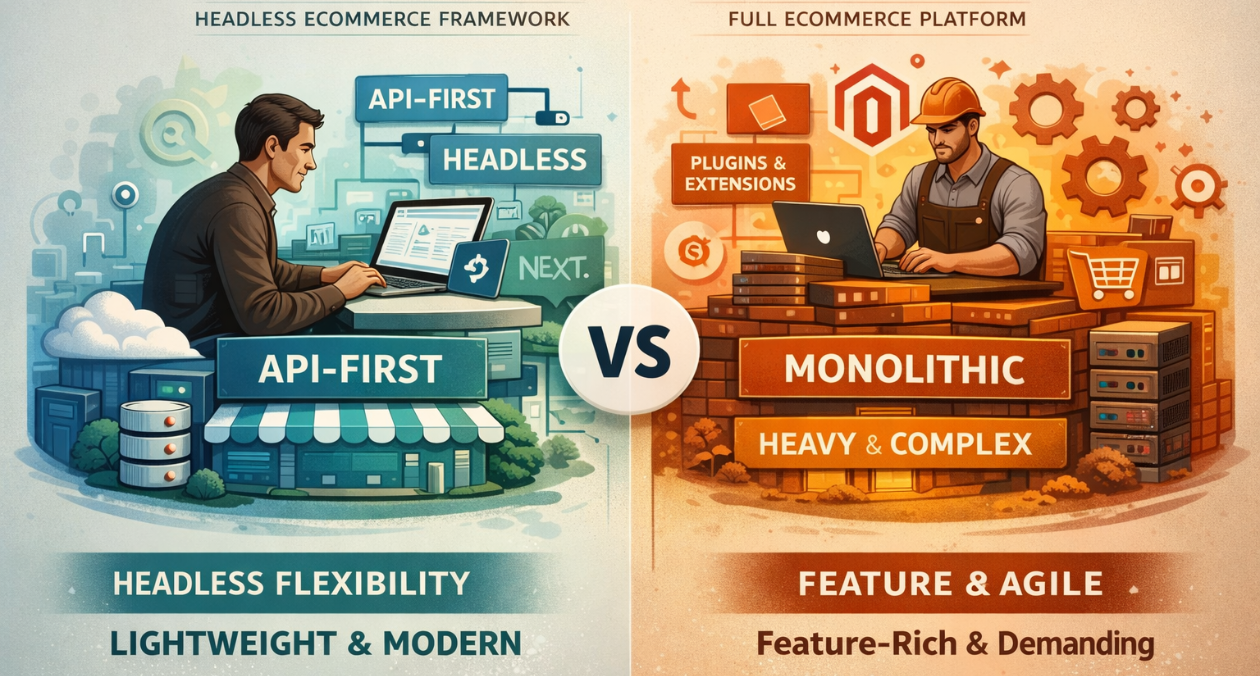
Choosing an ecommerce platform today is no longer about ticking feature checklists. It’s about understanding how the platform behaves as your business grows, how flexible it is when requirements change, and how much technical overhead it adds over time.
Two platforms that are often evaluated in this context are Magento and Medusa JS.
Although both are used to build ecommerce systems, they approach the problem from very different directions. That difference becomes clearer when you look at how they are built and used in real projects.
The Core Architectural Difference
Magento follows a traditional model where most ecommerce functionality lives inside one tightly connected system. This makes it powerful but also heavier to adapt when business needs change.
Medusa JS, on the other hand, is designed as an API-first, headless ecommerce framework. It separates commerce logic from presentation, allowing teams to build custom experiences without being constrained by the backend.
This architectural gap is the foundation of the Medusa JS vs Magento discussion.
Medusa JS vs Magento – Feature & Architecture Comparison
What Working with Magento Is Like Over Time
Magento offers a rich ecosystem and mature features. For businesses that rely on complex catalogs, pricing rules, or B2B workflows, this can be useful.
However, as stores grow, teams often notice:
- Increasing server and hosting requirements
- Dependency on multiple extensions
- Slower development cycles for custom changes
- Careful planning required for upgrades
Magento is powerful, but it demands continuous attention and optimization.
How Medusa JS Feels in Real-World Builds
Medusa JS focuses purely on commerce logic; orders, payments, fulfillment, products, without forcing design or frontend decisions.
This approach allows:
- Faster custom development
- Easier integration with modern frontends like Next.js
- Better alignment with cloud-native and containerized setups
- Cleaner separation between business logic and UI
For teams building tailored ecommerce solutions, this flexibility becomes a major advantage.
Considering Medusa.js for your next commerce build?
Our team at Askan Commerce helps businesses design scalable headless architectures, build custom storefronts, and implement MedusaJS tailored to real business needs.
Performance and Scalability Comparison
This is why Medusa JS is often evaluated as a Magento alternative when performance and scalability become critical.
Cost and Maintenance Over Time
Making the Right Choice
Magento remains a solid choice for businesses that already rely on its ecosystem and built-in enterprise features.
Medusa JS is better suited for organizations that want:
- A headless ecommerce platform from day one
- Full control over custom workflows
- A modern ecommerce stack that scales cleanly
- Reduced long-term technical debt
There is no universal winner; only what aligns better with long-term goals.
When do you pick and which one to pick
The Medusa JS vs Magento comparison is ultimately about choosing between two approaches to ecommerce architecture.
Magento represents a mature, feature-rich system that has powered ecommerce for years.
Medusa JS reflects the shift toward headless, composable, and API-driven commerce.
Understanding this distinction helps businesses choose a foundation they won’t need to rethink every few years.
Most popular pages
-

Image Optimization for Web Performance: Formats and Compression
Ask a developer why a page feels slow, and the honest answer is often sitting right in the middle of it. A single unoptimised...
-

Monolith vs Microservices: Choosing the Right Architecture for Your Team
Microservices have dominated architecture conversations for years, to the point where choosing a monolith can feel like admitting you're behind the times. In practice,...
-

Magento Performance Tuning: Caching Layers Explained
Magento has a reputation for being resource-heavy, and while some of that is inherent to running a full-featured enterprise commerce platform, a large share...
Image Optimization for Web Performance: Formats and Compression
Ask a developer why a page feels slow, and the honest answer is often sitting right in the middle of it. A single unoptimised...
Monolith vs Microservices: Choosing the Right Architecture for Your Team
Microservices have dominated architecture conversations for years, to the point where choosing a monolith can feel like admitting you're behind the times. In practice,...
Magento Performance Tuning: Caching Layers Explained
Magento has a reputation for being resource-heavy, and while some of that is inherent to running a full-featured enterprise commerce platform, a large share...