




TABLE OF CONTENTS
Magento to Headless: Signs Your Store Has Outgrown Monolith

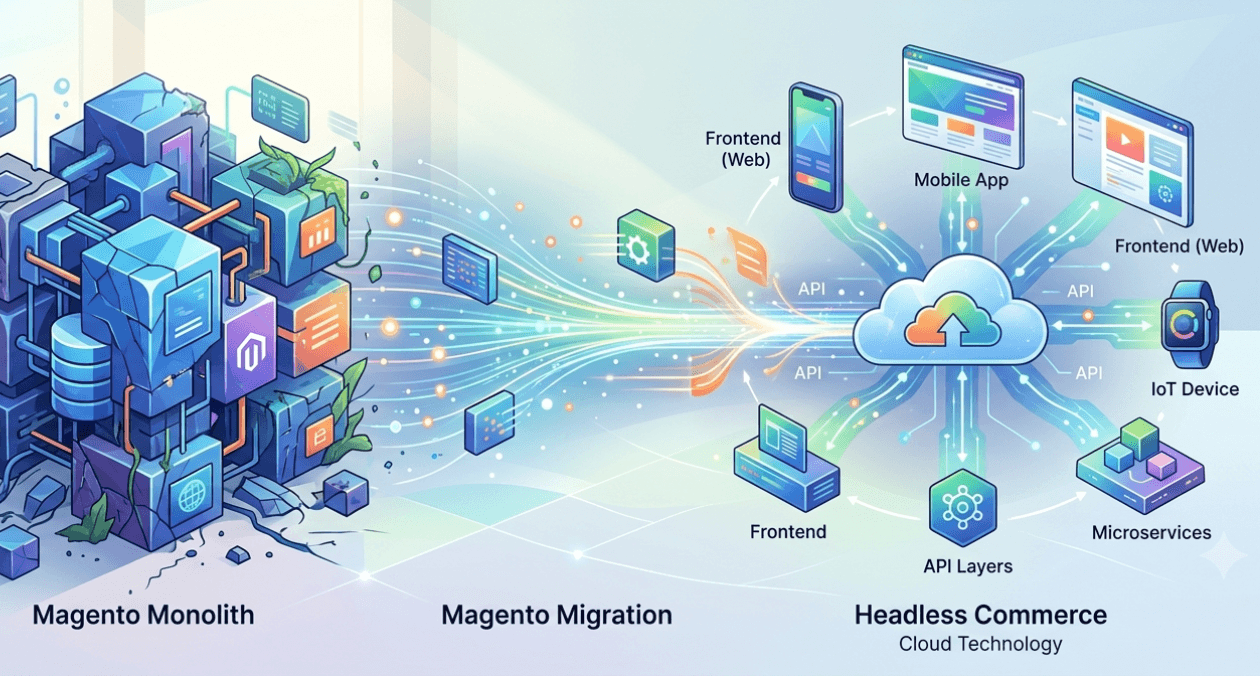
Magento to headless migration conversations tend to start reactively, usually after a specific frustration, a slow page load, a blocked feature request, or a scaling issue during peak sales, rather than as a planned strategic evaluation. This guide covers the concrete when to go headless commerce signals worth watching for, so CTOs and ecommerce managers can make this call proactively rather than under pressure.
Understanding the Core Magento Monolith Limitations
Magento, like most traditional ecommerce platforms, tightly couples the frontend presentation layer with the backend commerce logic, which means frontend changes often require backend deployment cycles and testing, slowing down the pace at which a marketing or design team can iterate on the customer-facing experience. This coupling also limits deployment flexibility, since scaling the frontend independently of backend commerce processing is difficult or impossible in a traditional monolithic architecture, forcing teams to scale the entire application even when only frontend traffic is the actual bottleneck.
Performance ceiling is another recurring magento monolith limitations pattern, since heavily customised Magento installations, particularly ones accumulated over years with numerous extensions, tend to become progressively harder to optimise for speed without extensive, risky refactoring of deeply interconnected legacy code.
Headless Commerce Signs Worth Watching For
A clear headless commerce signs pattern emerges when your team consistently wants to build customer experiences, such as a highly interactive product configurator, a native mobile app sharing the same backend, or content-rich landing pages, that feel genuinely difficult or impossible within Magento’s templating constraints without extensive custom development that fights against the platform rather than working with it. Frequent conflicts between marketing’s desire for rapid frontend experimentation and the technical reality of Magento deployment cycles is another reliable indicator that your organisation has outgrown what the monolithic architecture was designed to support.
Performance issues that persist despite reasonable optimisation effort, particularly on mobile where Core Web Vitals directly affect both SEO and conversion, often point to an architectural ceiling that incremental Magento performance tuning cannot fully resolve, since a fundamentally coupled frontend and backend architecture has inherent limits on how fast the customer-facing experience can become.
| Signal | What It Indicates | Headless Generally Helps |
| Slow, blocked frontend iteration | Deployment coupling is limiting agility | Yes, decouples release cycles |
| Persistent mobile performance issues | Architectural performance ceiling | Yes, frontend can be rebuilt for speed |
| Need for multiple frontend channels | Single backend feeding app, web, kiosk | Yes, headless serves multiple frontends |
"Get your migration assessment"
What a Realistic Migration Path Looks Like
A full magento to headless migration rarely happens as a single, risky cutover, and most successful transitions instead take a phased approach, migrating specific high-value pages or sections to a headless frontend first while the rest of the store continues running on Magento, gradually expanding the headless footprint as confidence and infrastructure mature. This phased strategy reduces risk considerably and gives teams real production data on performance and conversion improvements before committing to a full migration of the entire storefront.
Retaining Magento as a backend commerce engine while adopting a headless frontend layer, rather than replacing the backend entirely, is also a reasonable middle-ground path for organisations not ready to fully migrate off Magento’s backend commerce logic and existing integrations.
Making the Decision With Real Data Rather Than Frustration Alone
Before committing to a migration, auditing specific pain points against actual business impact, lost conversion from slow pages, engineering hours spent on workarounds, missed feature opportunities, gives a clearer business case than reacting to a single frustrating incident alone. Askan Tech’s migration assessments look at this exact evidence base before recommending a path forward, available through Askan Tech’s services page for teams evaluating this decision seriously.
Most popular pages
-

Image Optimization for Web Performance: Formats and Compression
Ask a developer why a page feels slow, and the honest answer is often sitting right in the middle of it. A single unoptimised...
-

Monolith vs Microservices: Choosing the Right Architecture for Your Team
Microservices have dominated architecture conversations for years, to the point where choosing a monolith can feel like admitting you're behind the times. In practice,...
-

Magento Performance Tuning: Caching Layers Explained
Magento has a reputation for being resource-heavy, and while some of that is inherent to running a full-featured enterprise commerce platform, a large share...
Image Optimization for Web Performance: Formats and Compression
Ask a developer why a page feels slow, and the honest answer is often sitting right in the middle of it. A single unoptimised...
Monolith vs Microservices: Choosing the Right Architecture for Your Team
Microservices have dominated architecture conversations for years, to the point where choosing a monolith can feel like admitting you're behind the times. In practice,...
Magento Performance Tuning: Caching Layers Explained
Magento has a reputation for being resource-heavy, and while some of that is inherent to running a full-featured enterprise commerce platform, a large share...