




TABLE OF CONTENTS
Custom Magento Extensions vs Third-Party Modules: Making the Right Call

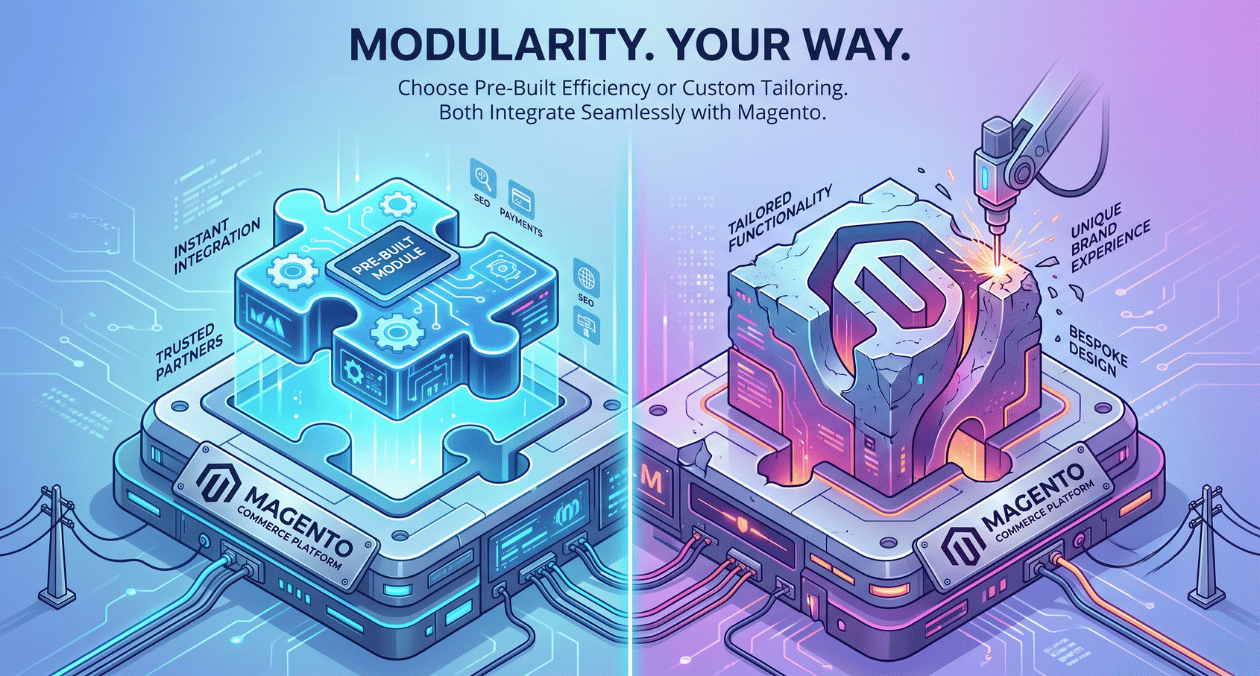
Every Magento store eventually needs functionality the platform does not offer out of the box, and the decision between building a custom extension or buying a third-party module gets made too often on gut feeling rather than a clear evaluation of the actual trade-offs involved. Getting this decision wrong either wastes development budget on something a module already solves well, or locks a store into a third-party dependency that becomes a maintenance liability.
What Third-Party Modules Actually Offer
A well-maintained third-party module from a reputable vendor typically ships faster than a custom build, has already been tested across a wide range of Magento configurations, and comes with ongoing updates that track new Magento releases without requiring your own development time. For common, well-defined functionality, advanced search, loyalty programs, standard payment integrations, this maturity and speed advantage is usually decisive.
Where Custom Extensions Make More Sense
Custom development becomes the better choice when the required functionality is specific to your business logic in a way no off-the-shelf module reasonably anticipates, when you need tight, non-standard integration with internal systems, or when a store’s scale and complexity make a generic third-party solution’s inefficiencies genuinely costly at your transaction volume. Custom code also avoids the risk of inheriting a third-party vendor’s technical debt or abandoned support.
Comparing the Two Approaches
| Factor | Third-Party Module | Custom Extension |
| Time to implement | Faster, often days | Slower, weeks to months |
| Ongoing maintenance | Vendor-managed, if actively supported | Your team’s responsibility |
| Fit to unique business logic | Limited to module’s configuration options | Built exactly to specification |
The Hidden Cost of Third-Party Modules
The upfront cost of a third-party module is rarely the full picture. Modules that stop receiving updates, conflict with other installed extensions, or require workarounds to fit slightly non-standard business logic can accumulate hidden maintenance cost over time that eventually exceeds what a custom build would have cost from the start. Checking a module’s update history and community reputation before purchase reduces this risk considerably, but does not eliminate it entirely.
The Hidden Cost of Custom Extensions
Custom code carries its own long-term liability: it needs to be actively maintained through every Magento upgrade, by your own team or a retained developer, rather than benefiting from a vendor’s shared maintenance across many customers. A custom extension built once and never revisited tends to accumulate compatibility issues with each Magento version bump, becoming increasingly risky and expensive to upgrade the longer it goes untouched.
A Practical Decision Framework
- Check whether a reputable, actively maintained module already solves the need adequately
- If a module exists but requires significant configuration workarounds to fit your business logic, weigh that against a custom build’s cost
- For functionality tightly coupled to unique, proprietary business logic, default to custom development
- Budget for ongoing maintenance in either direction, module licensing and updates, or your own team’s upgrade time for custom code
For stores weighing this decision on a specific feature, reviewing Askan’s Magento development and extension work covers both approaches across different merchant scales, which can help clarify whether a specific requirement genuinely justifies custom development or whether a mature existing module already covers the need adequately.
Most popular pages
-

Image Optimization for Web Performance: Formats and Compression
Ask a developer why a page feels slow, and the honest answer is often sitting right in the middle of it. A single unoptimised...
-

Monolith vs Microservices: Choosing the Right Architecture for Your Team
Microservices have dominated architecture conversations for years, to the point where choosing a monolith can feel like admitting you're behind the times. In practice,...
-

Magento Performance Tuning: Caching Layers Explained
Magento has a reputation for being resource-heavy, and while some of that is inherent to running a full-featured enterprise commerce platform, a large share...
Image Optimization for Web Performance: Formats and Compression
Ask a developer why a page feels slow, and the honest answer is often sitting right in the middle of it. A single unoptimised...
Monolith vs Microservices: Choosing the Right Architecture for Your Team
Microservices have dominated architecture conversations for years, to the point where choosing a monolith can feel like admitting you're behind the times. In practice,...
Magento Performance Tuning: Caching Layers Explained
Magento has a reputation for being resource-heavy, and while some of that is inherent to running a full-featured enterprise commerce platform, a large share...