




TABLE OF CONTENTS
Magento to Medusa.js: A Realistic Migration Roadmap for Enterprise Merchants

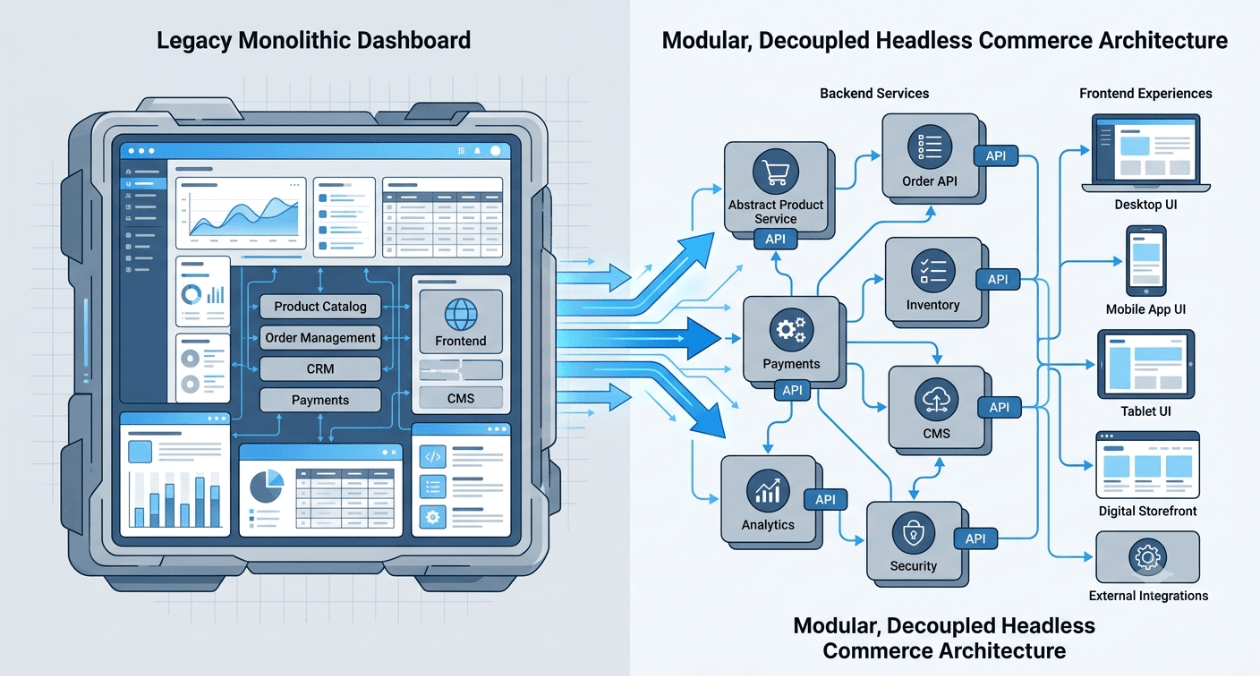
Enterprise merchants running large Magento catalogs are asking a harder question in 2026 than they did a few years ago. It is no longer just about upgrade costs. It is about whether a monolithic platform can keep pace with a business that wants faster releases, cleaner APIs, and a checkout experience it fully controls. Medusa.js has become one of the more credible answers to that question, and this roadmap walks through what an honest migration timeline actually looks like, phase by phase, along with the mistakes enterprise teams tend to repeat.
Why Magento Stops Fitting at Enterprise Scale
Magento was built for a different era of ecommerce, one where a single monolithic codebase handling catalog, checkout, and admin in one place was considered flexible enough. At enterprise scale, that same architecture starts working against the business. Every extension added to handle a new payment method or shipping rule increases the risk of conflicts during the next core update. Adobe Commerce licensing tiers scale with revenue, which means the platform gets more expensive exactly when a merchant is trying to reinvest in growth. Release cycles slow down because any storefront change has to be tested against a tightly coupled backend. Teams that work with an ecommerce development partner on large Magento estates tend to notice the same pattern surface around year three or four of a deployment: the platform still runs, but every new feature takes longer to ship than it should.
What Actually Changes When You Move to Medusa.js
Medusa.js takes a fundamentally different approach. Instead of one large application, commerce logic is split into modules for products, pricing, carts, orders, and fulfilment, each of which can be extended or replaced without touching the rest of the system. The admin dashboard is decoupled from the storefront, so a merchant can rebuild the customer facing experience in Next.js, Remix, or any modern framework without waiting on backend changes. Because the core is open source, licensing cost turns into an infrastructure line item rather than a revenue-based fee. Merchants exploring a Medusa.js ecommerce development partner usually start here, because the framework rewards teams that already understand their own commerce logic well enough to model it as services rather than as one large application.
| Aspect | Magento | Medusa.js |
|---|---|---|
| Architecture | Monolithic, frontend and backend coupled | Headless, modular commerce engine |
| Licensing | Paid Adobe Commerce tiers at scale | Open source core, infrastructure cost only |
| Customisation | Overriding core modules and plugins | Extending services without core changes |
| Release speed | Slower, tied to platform upgrade cycles | Faster, controlled by the engineering team |
The Realistic Migration Roadmap
A Magento to Medusa.js migration rarely succeeds as a single cutover event. It works better as a sequence of phases, each with its own exit criteria. Discovery starts with a full audit of the existing catalog structure, custom attributes, pricing rules, and every third party integration touching the store, from ERPs to tax engines. Architecture and module mapping follows, where each Magento capability gets mapped to a Medusa module or a custom service, and gaps are flagged early rather than discovered mid build. Storefront development happens in parallel once the backend contracts are stable, since Medusa’s headless nature means frontend work does not have to wait for every backend module to be finished. A parallel run phase keeps both systems live so real orders can be reconciled between them before anyone commits to a full cutover. Only after that reconciliation is clean does the final cutover and stabilisation phase begin.
| Migration Phase | Typical Duration |
|---|---|
| Discovery and data audit | 3 to 4 weeks |
| Architecture and module mapping | 4 to 6 weeks |
| Storefront build | 6 to 10 weeks |
| Parallel run and QA | 3 to 4 weeks |
| Cutover and stabilisation | 2 to 3 weeks |
Common Pitfalls Enterprise Teams Hit
The most common mistake is underestimating catalog complexity. A Magento catalog that has grown organically for years often carries attribute sets and pricing rules nobody fully documented, and those need to be reverse engineered before they can be modelled in Medusa. Tax and multi region logic is another area where teams assume a like for like mapping exists, when in practice regional tax rules need to be rebuilt as explicit Medusa configurations. Integration debt with ERPs and warehouse systems is frequently the reason timelines slip, since those connections were often built as tightly coupled Magento modules rather than clean APIs. It also helps to check the official Magento data export documentation early in discovery, since it defines exactly what can be extracted cleanly and what will need manual reconciliation. Redirect mapping for SEO is easy to leave until the end, and that is usually a mistake, since ranking losses from a messy migration take months to recover from.
Deciding If the Timeline Works for Your Business
The roadmap above assumes a mid to large catalog with a handful of integrations, not a store with hundreds of custom modules bolted onto the Magento core. Businesses with heavier customisation should budget more time in the architecture and mapping phase rather than compressing it to hit a fixed launch date. Technical readiness matters more than any calendar deadline here. A team that rushes the parallel run phase to save two weeks often spends much longer than that fixing order reconciliation issues after cutover. The merchants who get the most out of Medusa.js are the ones who treat the migration as a chance to clean up years of accumulated Magento workarounds, not just a lift and shift of the same logic onto a new stack.
Most popular pages
-

Image Optimization for Web Performance: Formats and Compression
Ask a developer why a page feels slow, and the honest answer is often sitting right in the middle of it. A single unoptimised...
-

Monolith vs Microservices: Choosing the Right Architecture for Your Team
Microservices have dominated architecture conversations for years, to the point where choosing a monolith can feel like admitting you're behind the times. In practice,...
-

Magento Performance Tuning: Caching Layers Explained
Magento has a reputation for being resource-heavy, and while some of that is inherent to running a full-featured enterprise commerce platform, a large share...
Image Optimization for Web Performance: Formats and Compression
Ask a developer why a page feels slow, and the honest answer is often sitting right in the middle of it. A single unoptimised...
Monolith vs Microservices: Choosing the Right Architecture for Your Team
Microservices have dominated architecture conversations for years, to the point where choosing a monolith can feel like admitting you're behind the times. In practice,...
Magento Performance Tuning: Caching Layers Explained
Magento has a reputation for being resource-heavy, and while some of that is inherent to running a full-featured enterprise commerce platform, a large share...