




TABLE OF CONTENTS
API Versioning Strategies That Do Not Break Your Clients Every Six Months

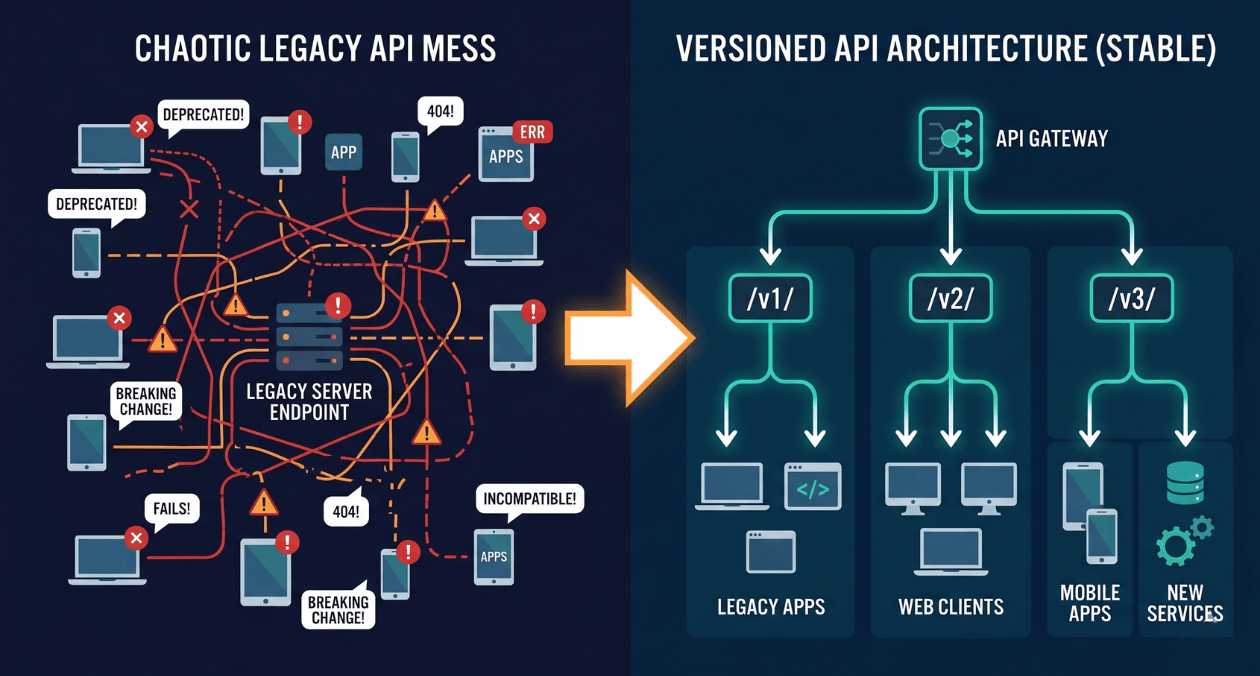
Every backend team eventually ships a change that breaks a client they forgot about. It usually happens the same way. The API contract looked stable. The change felt minor. The release went out on a Tuesday afternoon, and by Wednesday morning the support queue was full of integration partners reporting 500 errors and mobile app users on older builds seeing empty screens. The postmortem produces the same recommendation every time: we need a versioning strategy.
API versioning is one of those topics that feels straightforward until you are actually building it, at which point the tradeoffs between approaches start to matter in ways that a blog post overview rarely captures honestly. This article covers the four mainstream versioning strategies, what each costs in terms of maintenance overhead and client experience, how to design a deprecation process that clients can actually follow, and how to make the decision that fits your API’s specific consumer profile. For teams building REST and GraphQL APIs on Node.js, Python, or any other backend stack, Askan’s API and backend engineering services address these architecture decisions as part of broader API design engagements.
Why API Versioning Is a Client Relationship Problem, Not a Technical One
The technical implementation of any versioning strategy is relatively straightforward. The hard part is the relationship it implies with every consumer of your API. A versioning strategy is a promise: it tells clients what stability guarantees they can rely on, how much notice they will get before a breaking change forces them to update, and what the migration path will look like. A team that picks a versioning strategy without thinking through these promises will make technical choices that are internally consistent but operationally painful for the clients who depend on them.
The first question to answer before choosing a strategy is: who are your API consumers and how much control do you have over their release cycle? If your API serves internal frontend teams on the same deployment cadence as the backend, you have a great deal of flexibility. If your API serves external integration partners with quarterly release cycles, independent mobile apps on stores with their own review timelines, or enterprise customers with change control processes that take weeks to approve an update, your versioning strategy needs to accommodate a much longer coexistence period between versions.
The second question is: what counts as a breaking change for your specific API? The answer is less obvious than it appears. Removing a field from a JSON response is clearly breaking. Adding a required request parameter is clearly breaking. Adding an optional field to a response is not breaking for most clients, but it breaks clients that deserialise into strict type definitions that reject unknown fields. The Stripe API versioning documentation is one of the most cited examples of a mature versioning strategy in the industry and is worth reading before finalising your own approach, not to copy it directly but to understand the reasoning behind the decisions a high-volume API team made after years of experience managing client compatibility.
The Four Versioning Strategies and Their Real Tradeoffs
URL Path Versioning
URL path versioning embeds the version identifier directly in the request path, typically as a prefix segment such as /api/v1/users or /api/v2/orders. This is the most widely adopted strategy because it is immediately visible, easy to route at the reverse proxy or gateway layer, and requires no special client configuration beyond using the correct URL.
The visibility advantage is also its primary limitation. Every version of every endpoint is a separate URL, which means clients must update URL strings to migrate between versions. Browser caches, CDN configurations, and API gateway routing rules all reference specific version paths. When a version is deprecated, every downstream system that hardcoded the URL must update. For APIs with a large number of distinct endpoints, this creates a significant surface area of URLs to maintain and eventually decommission.
URL versioning works best when the versioning unit is the entire API surface rather than individual endpoints. A clean v1-to-v2 migration where the entire contract changes is simpler to communicate and coordinate than a system where some endpoints are on v1 and others are on v3 because they changed at different times.
Header Versioning
Header versioning passes the requested API version in a custom HTTP request header, such as API-Version: 2026-04-01 or Accept: application/vnd.yourapi.v2+json. The URL stays clean and does not encode version information, which keeps resource identifiers stable across versions and avoids the proliferation of version-specific URL namespaces.
The cost of header versioning is discoverability and debuggability. A URL is self-documenting in a way that a header is not. When an integration partner pastes an example request from documentation into a tool like Postman or curl, missing the version header produces unexpected behaviour that is not immediately obvious from the URL alone. API gateways and reverse proxies that route based on headers require more configuration than path-based routing, and caching infrastructure that uses the URL as the cache key will incorrectly serve the same cached response to requests for different versions unless Vary headers are configured correctly.
Header versioning is the right choice when URL cleanliness and stable resource identifiers are higher priorities than immediate discoverability, which is typically the case for well-documented developer-facing APIs with a technically sophisticated consumer base.
Query Parameter Versioning
Query parameter versioning appends the version to the request URL as a query string parameter, such as /api/users?version=2 or /api/orders?v=2026-04-01. It shares the discoverability advantage of URL path versioning while keeping the base resource path stable, but it introduces complications at the caching layer because most HTTP caches treat URLs with different query strings as different cache keys, which can produce unexpected caching behaviour for version-specific responses.
Query parameter versioning is rare in production APIs used by external consumers because it feels less formal than path or header versioning and because the version identifier mixed into the query string alongside business parameters creates parsing ambiguity. It is occasionally seen in internal APIs or rapid-iteration APIs where developer experience is deprioritised relative to speed of implementation.
Date-Based Versioning
Date-based versioning, used most visibly by Stripe, assigns each version a calendar date string rather than an integer. A client pins to a specific date version such as 2024-06-01 and the API guarantees that the response shape and behaviour for that date version will not change, even as newer date versions introduce breaking changes. The API server maintains the response transformation logic to convert the current internal representation into the shape each date version expects.
Date-based versioning makes the deprecation timeline explicit: a version dated 2023-01-01 communicates its age clearly, which is a useful signal when communicating sunset timelines to clients. The operational cost is that the server must maintain transformation layers for every active date version, which accumulates over time and creates test coverage requirements for every supported version combination. This approach is appropriate for high-traffic public APIs where external clients have diverse and unpredictable release cadences and where the investment in maintaining multiple version transformations is justified by the client relationship value.
Versioning Strategy Comparison
| Strategy | Best Suited For | Main Limitation |
|---|---|---|
| URL Path (/v1/, /v2/) | Public APIs with broad consumer base, easy to route and debug | URL proliferation; clients must update hardcoded paths on migration |
| Header (API-Version: …) | Developer-focused APIs prioritising clean URLs and stable resource identifiers | Less discoverable; requires correct Vary header configuration for caching |
| Query Parameter (?v=2) | Internal or rapid-iteration APIs where convenience beats formality | Caching complications; feels informal for external developer consumers |
| Date-Based (2024-06-01) | High-volume public APIs needing precise deprecation communication | Server must maintain transformation layers for every active date version |
Designing an API versioning strategy for your platform?
Designing a Deprecation Process That Clients Will Actually Follow
Choosing a versioning strategy determines how versions are identified. Designing a deprecation process determines how versions are retired. Most API teams think harder about the former and insufficiently about the latter, which is why deprecated versions persist in production long after their intended sunset date because clients simply did not migrate in time.
A deprecation process that works in practice has four components: advance notice, machine-readable signals, migration tooling, and a hard sunset with no exceptions.
Advance Notice
The minimum deprecation notice period should be longer than the longest release cycle among your external consumers. For APIs serving enterprise customers, this typically means a minimum of six months notice for a breaking change. For APIs serving internal consumers on a continuous deployment cadence, four to six weeks is often sufficient. The notice period should be announced through multiple channels simultaneously: API documentation updates, email to registered developers, an in-product notification for dashboard users, and a changelog entry. Relying on documentation alone means the notice reaches developers who proactively check the docs and misses everyone else.
Machine-Readable Deprecation Signals
Every response from a deprecated API version should include the Deprecation and Sunset HTTP headers, which were standardised in RFC 8594. The Deprecation header carries a timestamp indicating when the version was declared deprecated. The Sunset header carries the date after which the API will no longer respond to requests for this version. These headers allow API clients and monitoring tools to detect deprecated version usage programmatically, which is significantly more reliable than expecting developers to read changelog entries.
Adding a log alert that fires when the number of requests using a deprecated version has not decreased after 30 days of deprecation gives the API team actionable visibility into which consumers have not started migrating, allowing proactive outreach before the sunset date.
Migration Tooling
A deprecation notice that tells clients what is changing without showing them how to migrate is less effective than one that includes a migration guide with specific before-and-after examples for every breaking change in the new version. If the new version introduces significant restructuring, providing a code snippet that translates a v1 request into the equivalent v2 request removes the ambiguity that causes developers to defer migration until the last week before sunset.
For high-volume public APIs, providing a compatibility shim that accepts v1-shaped requests and translates them server-side to v2 for a defined interim period reduces the pressure on clients with slow release cycles. The shim is not a substitute for migration but a bridge that prevents the hard sunset from causing production failures for clients that are mid-migration when the deadline arrives.
Hard Sunset with No Exceptions
The most common failure mode in API deprecation is extending the sunset date repeatedly in response to requests from clients who have not yet migrated. Each extension communicates to all other clients that deadlines are not real, which reduces the urgency of future migrations. Setting and holding a hard sunset date, and returning 410 Gone responses after that date for the deprecated version rather than 404 or 500, is what makes the deprecation process credible. A 410 response communicates that the resource is intentionally gone and is not a transient error, which produces a clearer error message in client-side error reporting than a 404 would.
Versioning at the API Gateway Layer
Regardless of which versioning strategy you choose, implementing the version routing at the API gateway layer rather than inside individual service code keeps the application services themselves version-agnostic and centralises the routing logic in one place that is independently deployable and testable.
An API gateway receives the versioned request, resolves which backend service and which route handler should process it based on the version identifier, and forwards the request. When a new version introduces a different service to handle a particular endpoint, the gateway configuration update is a routing rule change rather than a code deployment. When a version is sunset, removing the gateway rule for that version is a clean, auditable operation that does not touch service code.
Kong, AWS API Gateway, and Nginx with Lua scripting are the most commonly used implementations for this pattern. Kong’s versioning-by-path approach using route prefix matching is particularly straightforward to configure and is well-documented in the Kong Gateway documentation. Teams building on Kubernetes typically implement the gateway layer using an Ingress controller with path-based routing rules, where each API version maps to an Ingress rule that routes to the appropriate service version.
Designing an API versioning strategy for your platform?
GraphQL and the Versioning Question
GraphQL APIs are often described as not requiring versioning because the schema evolution model allows new fields to be added and old fields to be deprecated without breaking existing queries. This is largely true for additive changes, but the claim that GraphQL eliminates the need for versioning is overstated.
GraphQL schema deprecation marks individual fields with the deprecated directive and a reason string, which tools like GraphiQL and client-side code generators surface to developers. A deprecated field continues to function until it is removed from the schema, at which point any client query that references it will return an error. The deprecation and removal cycle is versioning under a different name, applied at the field level rather than the API level.
The practical challenge with GraphQL deprecation is tracking which clients are using deprecated fields. Unlike REST endpoints where version usage is visible in server logs by URL path or header value, GraphQL query structures are not consistently logged in a way that makes field-level usage analysis straightforward. Implementing query logging that captures the operation document or a parsed field set for every request, and then running queries against that log to identify clients still referencing deprecated fields, is the operational practice that makes GraphQL field deprecation work reliably rather than theoretically.
Internal APIs and the Temptation to Skip Versioning
Internal APIs, those consumed only by services within the same organisation, are frequently built without versioning under the reasoning that internal consumers are easier to coordinate and can be updated simultaneously with the API provider. This reasoning is defensible for very small systems where all consumers are owned by the same team and can genuinely be deployed together. It breaks down as soon as more than one team consumes the API or as soon as the deployment cadences of the provider and consumers diverge.
The minimum viable versioning practice for internal APIs is semantic versioning communicated through the API’s OpenAPI specification version field, with a clear team norm that a major version bump signals breaking changes and requires migration coordination. This does not require the infrastructure overhead of URL-based versioning or multi-version gateway routing, but it does provide the communication structure that prevents the class of incident where a backend team deploys a breaking internal API change and discovers that three downstream services broke simultaneously.
Consumer-driven contract testing is the complementary practice that makes internal API evolution safer without the overhead of formal versioning infrastructure. With tools like Pact, each consumer service publishes a contract describing which fields and response shapes it depends on. The provider service runs these contracts against its test suite before every deployment, which catches breaking changes before they reach a shared environment. This shifts the coordination burden from a release-time conversation to an automated pre-deployment check.
Making the Decision for Your Specific Context
After working through the strategies, deprecation mechanics, and gateway implementation options, most teams face the same decision-making moment: which approach fits our situation right now, given our consumer profile, our team size, and our tolerance for operational complexity.
| Your Situation | Recommended Starting Point |
|---|---|
| Public API with external developers and mobile clients on unknown release cycles | URL path versioning with date-anchored deprecation notices and a minimum 6-month sunset window |
| Internal API consumed by teams in the same organisation on similar deployment cadences | Semantic versioning via OpenAPI spec plus consumer-driven contract testing with Pact |
| Developer-focused API with technically sophisticated consumers who read documentation | Header versioning with RFC 8594 Deprecation and Sunset headers on all deprecated versions |
| High-volume public API where you need precise client compatibility guarantees | Date-based versioning with transformation layers per version, modelled on Stripe’s approach |
The most important constraint is to choose one strategy and apply it consistently rather than mixing strategies across different parts of the API. A system where some endpoints use URL versioning and others use header versioning forces clients to implement two different version resolution patterns, which doubles the documentation they need to read and the edge cases they need to handle. Consistency in the versioning surface is itself a form of client experience, and it is one that is entirely within the API team’s control. Askan’s backend and API engineering engagements help teams establish this consistency from the ground up, including gateway configuration, OpenAPI specification governance, and the deprecation communication workflows that keep client relationships healthy through API evolution.
Most popular pages
-
Magento to Headless: Signs Your Store Has Outgrown Monolith
Magento to headless migration conversations tend to start reactively, usually after a specific frustration, a slow page load, a blocked feature request, or a...
-

AMP Pages in 2026: Is It Still Worth Implementing
The question of is amp still worth it 2026 comes up regularly from publishers and SEO teams who adopted AMP years ago and are...
-

AI Code Review Tools: Where They Help and Where They Don’t
Ai code review tools 2026 has brought a genuine shift in how engineering teams catch bugs and style issues before a human reviewer even...
Magento to Headless: Signs Your Store Has Outgrown Monolith
Magento to headless migration conversations tend to start reactively, usually after a specific frustration, a slow page load, a blocked feature request, or a...
AMP Pages in 2026: Is It Still Worth Implementing
The question of is amp still worth it 2026 comes up regularly from publishers and SEO teams who adopted AMP years ago and are...
AI Code Review Tools: Where They Help and Where They Don’t
Ai code review tools 2026 has brought a genuine shift in how engineering teams catch bugs and style issues before a human reviewer even...