




TABLE OF CONTENTS
AMP for Ecommerce in 2026: Is It Still Worth Implementing?


For a few years, AMP was the fastest route to a spot in Google’s mobile carousel, and ecommerce teams built entire template libraries around it. In 2026, that landscape looks nothing like it did back in 2018. Google folded AMP’s search perks into the broader Page Experience signal in 2021, and adoption among online stores has been sliding ever since. Yet the question still comes up in planning meetings: should a growing ecommerce brand build AMP pages today, particularly in markets where mobile networks are still catching up. This piece looks at what AMP actually offers now, where it falls short, and how to make the call without guessing, using the current state of Core Web Vitals and search behaviour as the baseline rather than assumptions carried over from 2018.
What AMP for Ecommerce Actually Means Today
AMP, short for Accelerated Mobile Pages, is a restricted flavour of HTML that trades flexibility for guaranteed speed. A page built on the AMP spec uses a limited tag set, tight inline styling rules, and in many cases a Google managed cache that serves a pre rendered copy of the page to the shopper. For a product listing, that used to translate into an almost instant load, even over a shaky 3G connection. The tradeoff has never gone away though. AMP pages cannot run arbitrary JavaScript, which rules out most personalization logic, dynamic pricing widgets, live stock counters, and the third party trust badges that a lot of ecommerce teams depend on to lift conversion. Building a second, stripped down version of every product and category page also means keeping two templates in sync every time the storefront changes, which is a maintenance cost that rarely gets talked about upfront.
Why the AMP Conversation Changed After 2021
Google removed the AMP requirement for the Top Stories carousel in mid 2021 and replaced it with the Page Experience signal, which leans on Core Web Vitals, namely Largest Contentful Paint, Interaction to Next Paint, and Cumulative Layout Shift. Once that shift landed, AMP stopped being a prerequisite for visibility. A regular, well optimised product page could now compete on the same terms as an AMP page, without giving up JavaScript features. That single policy change is the biggest reason AMP adoption across ecommerce has fallen so sharply since 2021, and it is worth reading Google’s own explanation of how these metrics are scored, available at web.dev, before your team decides where to invest next quarter. For most stores, that means the budget once earmarked for a parallel AMP build can go straight into speeding up the primary storefront instead, which benefits every page rather than a stripped down subset of them.
AMP vs Core Web Vitals: A Side by Side Look
| Aspect | AMP Approach | Core Web Vitals Approach |
| Search visibility | No longer required for special placement | Measured directly on your live, regular page |
| Development effort | Separate AMP template to build and maintain | Same codebase, tuned for speed |
| JavaScript freedom | Very limited, blocks most custom scripts | Full framework flexibility |
| Long term upkeep | Two page versions to keep in sync | One version to maintain |
Where AMP Genuinely Still Helps
AMP has not disappeared completely, and there are still a handful of scenarios where it earns its keep in 2026. Publishers running a commerce section alongside editorial content still see some value from AMP, since Google’s News surfaces continue to favour it in certain markets. Stores selling heavily into regions with inconsistent 3G or 4G coverage, including parts of rural India and Southeast Asia, sometimes see a real bounce rate improvement on AMP product pages purely because of the guaranteed load time on a weak connection. Email commerce is another pocket worth mentioning separately from web AMP. Askan Technologies’ own work on AMP for email lets brands embed a live product carousel or a working add to cart button directly inside a promotional email, without sending the shopper anywhere else first, which is a genuinely different use case from AMP web pages and one that has not seen the same decline.
What Most Ecommerce Teams Use Instead
For everyone outside those specific cases, the more common path in 2026 is a fast, standard storefront rather than a parallel AMP build. Server side rendering with a framework such as Next.js, combined with edge caching on a CDN, gets a product page to first paint almost as quickly as AMP used to, while keeping full JavaScript freedom for personalization and dynamic pricing. Lazy loading images below the fold, serving modern formats such as AVIF or WebP, and trimming third party scripts down to the essentials usually account for most of the visible speed gain teams are chasing when they first consider AMP. Reducing render blocking resources and setting proper priority hints on the largest image on the page also closes a big part of the gap that AMP used to solve automatically. Teams that want a second opinion on where their storefront currently stands often start with an ecommerce development audit before deciding whether AMP still belongs on the roadmap at all.
A Simple Decision Framework
| Scenario | What To Do |
| Your traffic is mostly from a market with strong 4G or 5G coverage | Skip AMP, invest that effort into Core Web Vitals instead |
| You run a news or content heavy commerce section | AMP may still be worth testing for that section only |
| You already send AMP email campaigns | Keep AMP for email, it is a separate use case from AMP web pages |
| Your dev team is small and already stretched | Do not add a second template to maintain, focus on one fast storefront |
Mistakes Teams Make When Revisiting AMP
A few mistakes come up repeatedly when ecommerce teams revisit their old AMP setup in 2026. The most common one is leaving AMP pages live purely out of habit, without checking whether they still get meaningful traffic from AMP specific surfaces. Running a quick audit through Search Console often reveals that an AMP template built in 2019 is now serving almost no unique sessions, while still costing engineering time every release cycle. Another frequent issue is conflating AMP for web with AMP for email. The two share a name and a restricted markup philosophy, but they solve different problems and have had very different adoption curves since 2021. Treating them as one decision, rather than two separate ones, tends to lead teams to either keep AMP everywhere out of caution, or drop it everywhere including the email use case where it still performs well.
There is also a measurement gap worth closing before making the call either way. Comparing bounce rate and conversion on your AMP pages against your regular mobile pages, segmented by connection speed if your analytics setup allows it, gives a far more honest answer than assuming AMP is either obsolete or essential. Stores with a meaningful share of shoppers on 3G, common in tier two and tier three markets across India, sometimes find their AMP product pages still convert measurably better on that segment alone, even while the format has fallen out of favour everywhere else. That kind of segmented data, rather than a blanket policy either way, is what should actually drive the decision on a page by page or region by region basis rather than a single site wide rule.
The short version is that AMP for ecommerce in 2026 is a narrow tool rather than a default choice, and most stores are better served putting that same effort into speeding up the storefront shoppers already land on. If your team is still on the fence, a scoped four week trial on one high traffic category, with AMP running alongside a speed optimised regular page for comparison, usually settles the debate faster than another round of internal discussion. Whichever way the data points, the decision is worth revisiting every year or two rather than locking in a five year old assumption, since both the AMP ecosystem and Core Web Vitals thresholds keep shifting as Google refines what a good page experience actually looks like.
Most popular pages
-

Choosing Between REST and GraphQL for Your Next API
REST and GraphQL both solve the same underlying problem, letting a frontend fetch and modify data from a backend, but they approach it with...
-
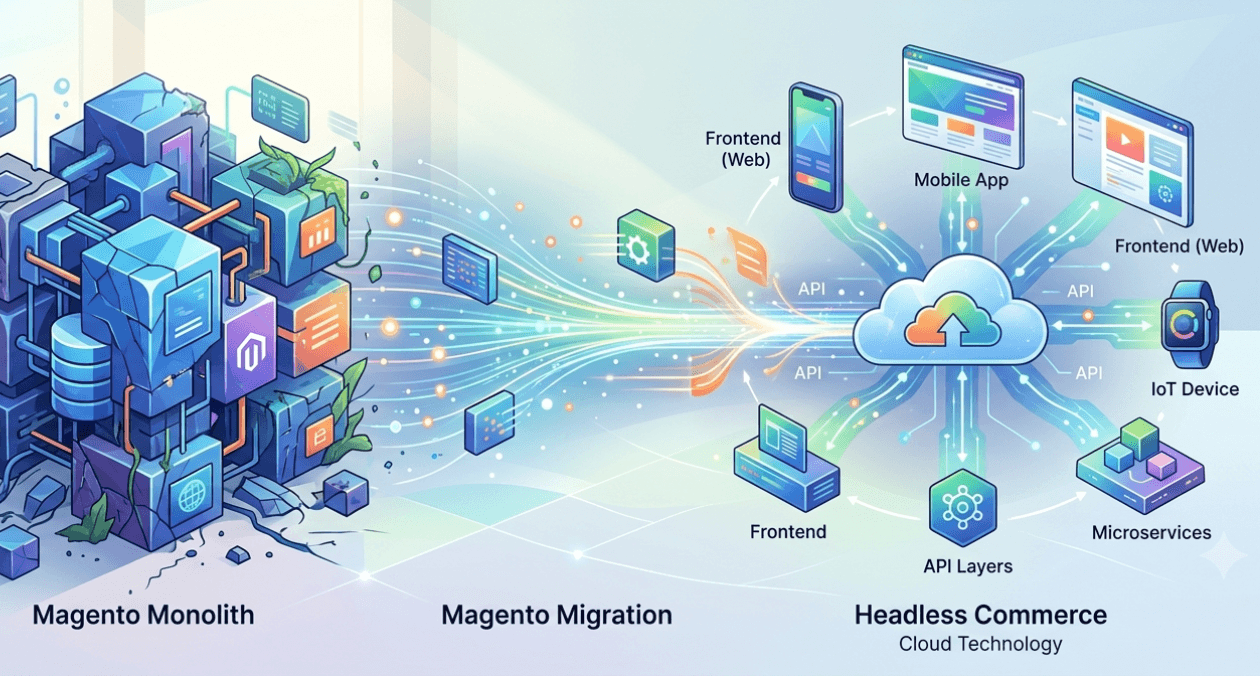
Magento to Headless: Signs Your Store Has Outgrown Monolith
Magento to headless migration conversations tend to start reactively, usually after a specific frustration, a slow page load, a blocked feature request, or a...
-

AMP Pages in 2026: Is It Still Worth Implementing
The question of is amp still worth it 2026 comes up regularly from publishers and SEO teams who adopted AMP years ago and are...
Choosing Between REST and GraphQL for Your Next API
REST and GraphQL both solve the same underlying problem, letting a frontend fetch and modify data from a backend, but they approach it with...
Magento to Headless: Signs Your Store Has Outgrown Monolith
Magento to headless migration conversations tend to start reactively, usually after a specific frustration, a slow page load, a blocked feature request, or a...
AMP Pages in 2026: Is It Still Worth Implementing
The question of is amp still worth it 2026 comes up regularly from publishers and SEO teams who adopted AMP years ago and are...