




TABLE OF CONTENTS
Medusa.js vs Shopify Hydrogen: Which Headless Commerce Stack Should You Build On?

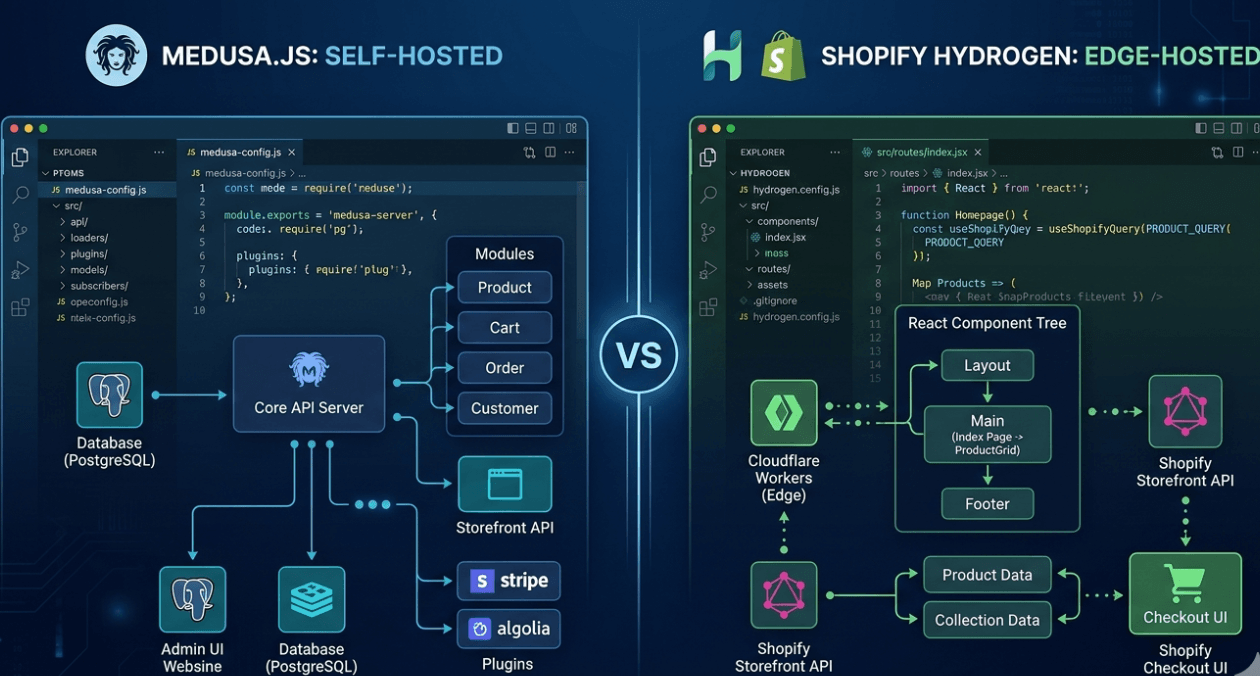
The headless commerce conversation has shifted. Teams are no longer asking whether to go headless. They are asking which stack actually holds up once the traffic climbs, the product catalog grows, and the business requirements get complicated. Two stacks consistently come up in engineering discussions: Medusa.js and Shopify Hydrogen. Both position themselves as developer-first frameworks for building modern storefronts. Both promise flexibility and performance. But they are built on fundamentally different assumptions about where your control ends.
This article lays out an honest comparison: the architecture, the tradeoffs, the real-world friction, and the decision factors that actually matter when you are about to commit a development team to one of these paths.
What Each Stack Actually Is
Medusa.js
Medusa.js is an open-source, Node.js-based headless commerce engine. You self-host it or deploy it on any cloud provider. The backend handles orders, products, customers, carts, and fulfilment through a modular system. The frontend is entirely your call. Teams commonly pair it with Next.js storefronts or custom React builds. Because Medusa owns nothing about your infrastructure, you control the database, the caching layer, the deployment environment, and the extension model.
Shopify Hydrogen
Hydrogen is Shopify’s React-based storefront framework, built specifically to sit in front of the Shopify backend. It runs on Cloudflare Workers by default through Oxygen, Shopify’s hosted edge runtime. Hydrogen gives you composability on the frontend while Shopify retains control of the backend, the checkout, the payment processing, and the order management layer.
Architecture at a Glance
| Dimension | Medusa.js | Shopify Hydrogen |
| Backend ownership | Fully yours | Shopify’s infrastructure |
| Frontend framework | Any (Next.js, Remix, custom) | React via Hydrogen |
| Hosting | Self-hosted or any cloud | Oxygen (Cloudflare Workers) |
| Checkout control | Full control, customisable | Shopify checkout only |
| Licensing | MIT open source | Commercial (Shopify fees apply) |
| Database | PostgreSQL, self-managed | Shopify-managed |
Developer Experience: Where the Differences Show Up Early
Both frameworks have improved significantly in the past year, but the developer experience gap becomes apparent once you move past the starter template.
With Hydrogen, the setup is fast. Shopify’s CLI handles scaffolding, and the connection to the Storefront API is pre-wired. A team can have a working demo storefront in hours. The React Server Components model is baked in from the start, which suits frontend teams already familiar with the Next.js App Router patterns.
With Medusa.js, the setup takes longer because you are configuring the backend separately from the storefront. The module system introduced in Medusa 2.0 made this cleaner, but teams still need to think about database provisioning, environment variables, and the relationship between their API layer and their frontend. The upside is that this process forces architectural clarity early. Teams working with Askan’s Medusa.js development services typically spend the first sprint on this setup before moving fast in subsequent iterations.
Checkout: The Biggest Practical Difference
This is where the two stacks diverge most sharply, and it is often the deciding factor.
Shopify Hydrogen gives you a beautifully designed storefront that ends at Shopify’s checkout page. You can customise the checkout with Shopify’s Checkout Extensibility features, but the core checkout flow is Shopify’s and always will be. For most B2C merchants, this is fine. Shopify’s checkout converts well and handles payments, fraud detection, and compliance.
Medusa.js gives you a checkout you build yourself. That sounds like more work, because it is, but it also means you can build a checkout that handles multi-currency pricing, B2B approval flows, subscription billing, custom payment terms, or any combination of logic your business model requires. If your checkout logic is a competitive advantage or a business-specific requirement, Medusa is the only option that doesn’t eventually block you.
Build your headless commerce stack with Askan
Performance: What Teams Actually See in Production
Hydrogen running on Oxygen benefits from Cloudflare’s global edge network. Pages render close to the user by default, and the framework’s streaming architecture means time-to-first-byte is competitive. Shopify has invested heavily in this infrastructure, and it shows. The Core Web Vitals numbers are generally solid on well-built Hydrogen storefronts.
Medusa.js performance depends entirely on how you architect and deploy it. A team that sets up Redis caching, a CDN for assets, and a properly indexed PostgreSQL database will see excellent performance. A team that deploys Medusa on a single underpowered server without caching will see poor performance. The framework does not impose performance on you. You build it.
At scale, Medusa’s flexibility becomes an advantage. You can shard the database, add read replicas, cache aggressively at the API level, and run the backend as a microservice alongside other systems. Shopify’s infrastructure is managed, which removes that operational burden, but it also means you cannot optimise beyond what Shopify exposes.
Plugin and Extension Ecosystem
| Capability | Medusa.js | Shopify Hydrogen |
| Custom payment logic | Full control via plugins | Limited to Shopify Payment apps |
| CMS integration | Any headless CMS | Any headless CMS |
| ERP and OMS connections | Custom modules, full control | Via Shopify apps or APIs |
| Analytics and tracking | Any tool via custom events | Shopify analytics plus third-party |
Shopify’s app ecosystem is massive, which is a genuine advantage for merchants who want off-the-shelf solutions. There are apps for almost everything. The limitation is that these apps operate within Shopify’s permission model, and the more complex your requirements, the more likely you are to hit the ceiling of what an app can do.
Medusa’s plugin system is smaller but fundamentally more flexible. A custom Medusa module can reach into the database, modify the order flow, interact with external services, or override core behaviour. Teams building on Medusa.js with Askan often start with the core modules and extend them rather than depending on a pre-built ecosystem.
Total Cost of Ownership: An Honest Breakdown
This is where many evaluations go wrong. Teams compare initial build cost rather than the full cost picture over two to three years.
Shopify Hydrogen sits on top of Shopify Plus, which runs from roughly $2,300 per month for the base plan. Add transaction fees depending on your payment configuration, Shopify app subscriptions, and Oxygen hosting (currently included with Shopify plans). At high revenue volumes, the platform fees become significant.
Medusa.js is free to use. Your costs are infrastructure (cloud hosting for the backend, database, CDN), development time for setup and extensions, and ongoing engineering maintenance. At moderate traffic levels, infrastructure costs are low. As traffic scales, you control the cost optimisation levers rather than paying a platform percentage.
Build your headless commerce stack with Askan
When to Choose Shopify Hydrogen
Hydrogen makes genuine sense in a specific set of circumstances. If your business runs primarily B2C, your checkout logic is standard, and you want to move quickly with a team that knows Shopify, Hydrogen removes a lot of infrastructure complexity. The Shopify ecosystem handles payments, fraud, and compliance by default. You can build a high-performing custom storefront without owning the backend.
It also makes sense when you need the breadth of Shopify’s app integrations without building custom solutions. Merchants with established Shopify operations who want a faster, more custom frontend without a full replatform are a strong fit.
When to Choose Medusa.js
Medusa is the right call when your commerce logic is complex enough that a managed backend will eventually constrain you. Multi-vendor marketplace builds, B2B portals with custom pricing and approval workflows, subscription commerce with complex dunning logic, or marketplaces operating across multiple geographies with different tax and fulfilment rules all benefit from Medusa’s open architecture.
Medusa also makes sense when you are building a long-term platform rather than a storefront. If your commerce layer needs to integrate deeply with internal systems, expose APIs to partners, or serve as the foundation for multiple channels, the open-source model gives you durability that a managed platform cannot match. The ecommerce development team at Askan has implemented Medusa for clients ranging from growing D2C brands to B2B platforms that required custom workflows out of reach in managed platforms.
Migration Path Considerations
One practical factor often overlooked: what happens if you need to change later?
With Shopify Hydrogen, your frontend can be migrated to another backend because Hydrogen is “just React.” But your data, orders, customers, and product catalogue live in Shopify, and migrating that data out is not trivial. You are also migrating away from the checkout and all the app integrations you have built on top of Shopify.
With Medusa.js, you own your data from day one. The database is yours. Migrating the frontend is straightforward. Moving to a different backend engine, if you ever needed to, is a more significant effort, but the data portability reduces your lock-in significantly.
Most popular pages
-

Image Optimization for Web Performance: Formats and Compression
Ask a developer why a page feels slow, and the honest answer is often sitting right in the middle of it. A single unoptimised...
-

Monolith vs Microservices: Choosing the Right Architecture for Your Team
Microservices have dominated architecture conversations for years, to the point where choosing a monolith can feel like admitting you're behind the times. In practice,...
-

Magento Performance Tuning: Caching Layers Explained
Magento has a reputation for being resource-heavy, and while some of that is inherent to running a full-featured enterprise commerce platform, a large share...
Image Optimization for Web Performance: Formats and Compression
Ask a developer why a page feels slow, and the honest answer is often sitting right in the middle of it. A single unoptimised...
Monolith vs Microservices: Choosing the Right Architecture for Your Team
Microservices have dominated architecture conversations for years, to the point where choosing a monolith can feel like admitting you're behind the times. In practice,...
Magento Performance Tuning: Caching Layers Explained
Magento has a reputation for being resource-heavy, and while some of that is inherent to running a full-featured enterprise commerce platform, a large share...